
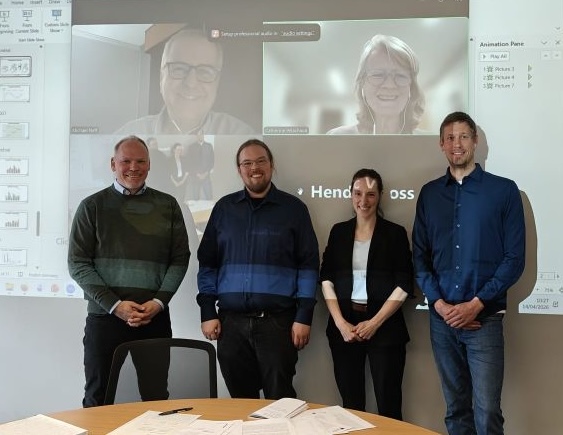
After 5 years of research, Hendric Voss defended his PhD thesis on generating semantically meaningful and contextually relevant gestures – Congratulations on a great, very “global” defense with examiners Prof. Catherine Pelachaud joining from Japan and Prof. Michael Neff from California (US).
Category Archives: News
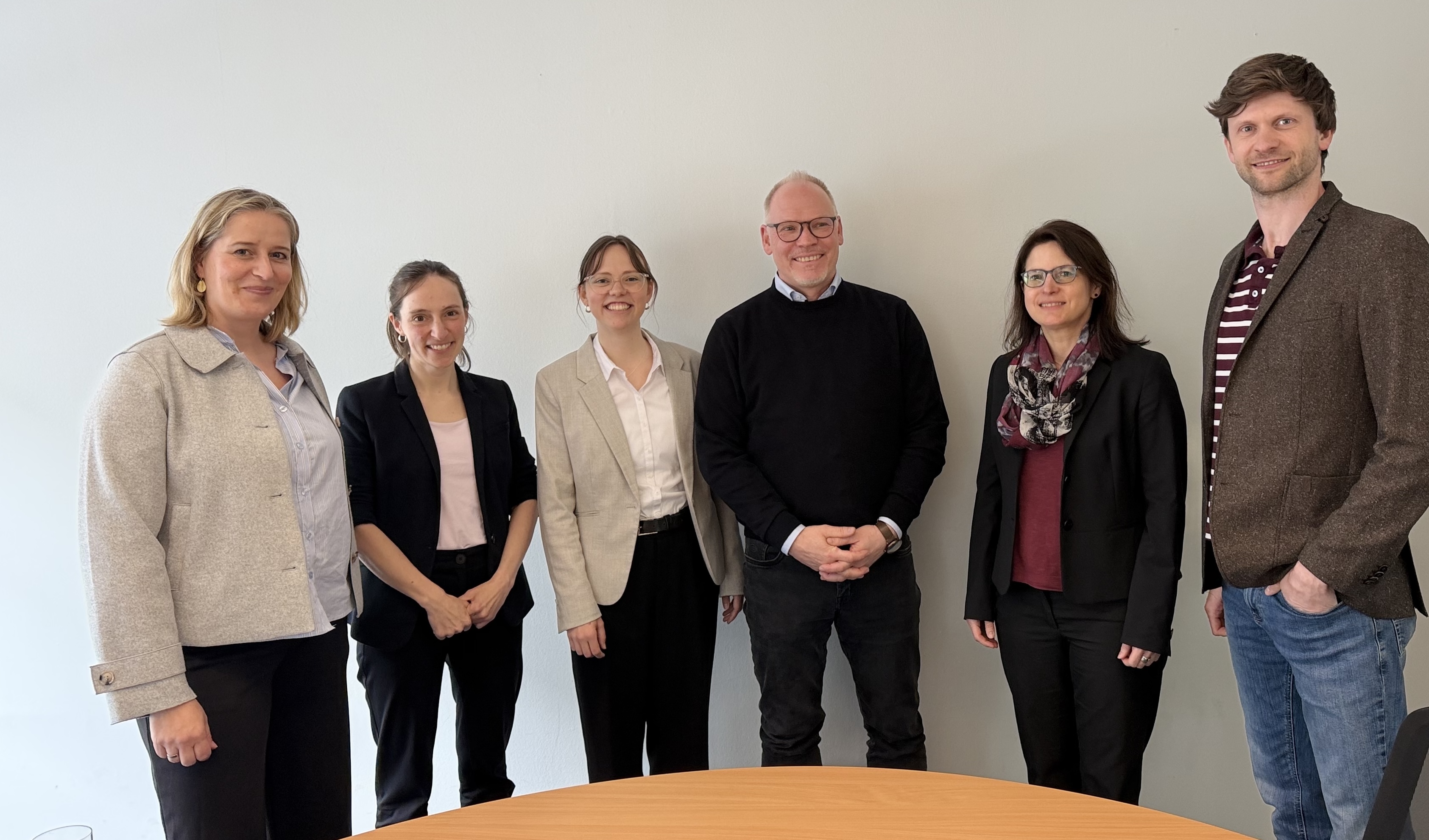
PhD graduation part 1 — Congratulations, Annika Österdiekhoff!
Annika Österdiekhoff successfully defended her PhD thesis on modeling a sense of control in RL agents. Congratulations!! And many thanks to Verena Hafner (Humboldt U, Berlin) and Nele Russwinkel (U Lübeck) for being on the examination committee.
Doctoral Network on Embodied Multimodal Communication funded by EU Horizon
Excited to share that we are part of a new MSCA Doctoral Network on “Embodied Multimodal Human Communication and Modeling” (EMHCAM) that just got accepted by the EU. Really looking forward to working with excellent partners from U Copenhagen (lead), Sorbonne U, KTH, UCL, KU Leuven, Trinity College Dublin, and others. We will be hiring two PhD students – stay tuned for announcements!

New paper out showing that a sense of control fosters AI agent learning of how to do multitasking
A new paper “Giving AI agents a sense of control facilitates reinforcement learning in multitasking scenarios” is now out and publicly available in PLOS One.
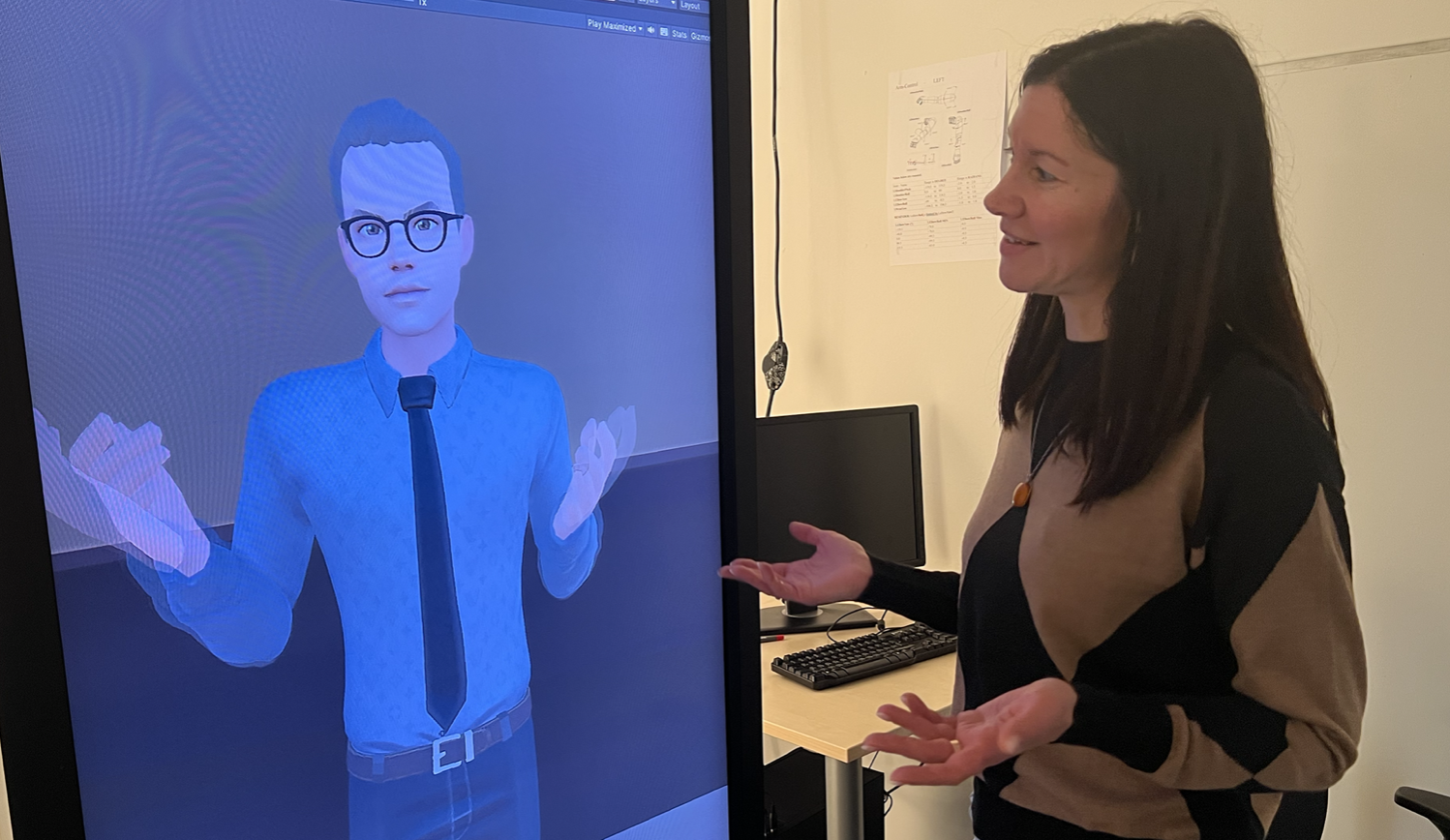
Workshop “Multimodal creativity in speech and gesture production” at ZiF
Join us at the ZiF in Bielefeld for a workshop on “Multimodal creativity in speech and gesture production” on Dec 1st and 2nd! We are looking forward to talks by James Trujillo (U of Amsterdam), Angela Grimminger & Luyao Wang (Paderborn U), Andy Lücking (Goethe U Frankfurt), Jiahao Yang (U of Bath), and Anna Palmann (U of Amsterdam), in addition to own Lisa Gottschalk, Alon Fishman and Lotta Heidemann (Bielefeld U). The event is organized by subproject C02 of CRC 1646.
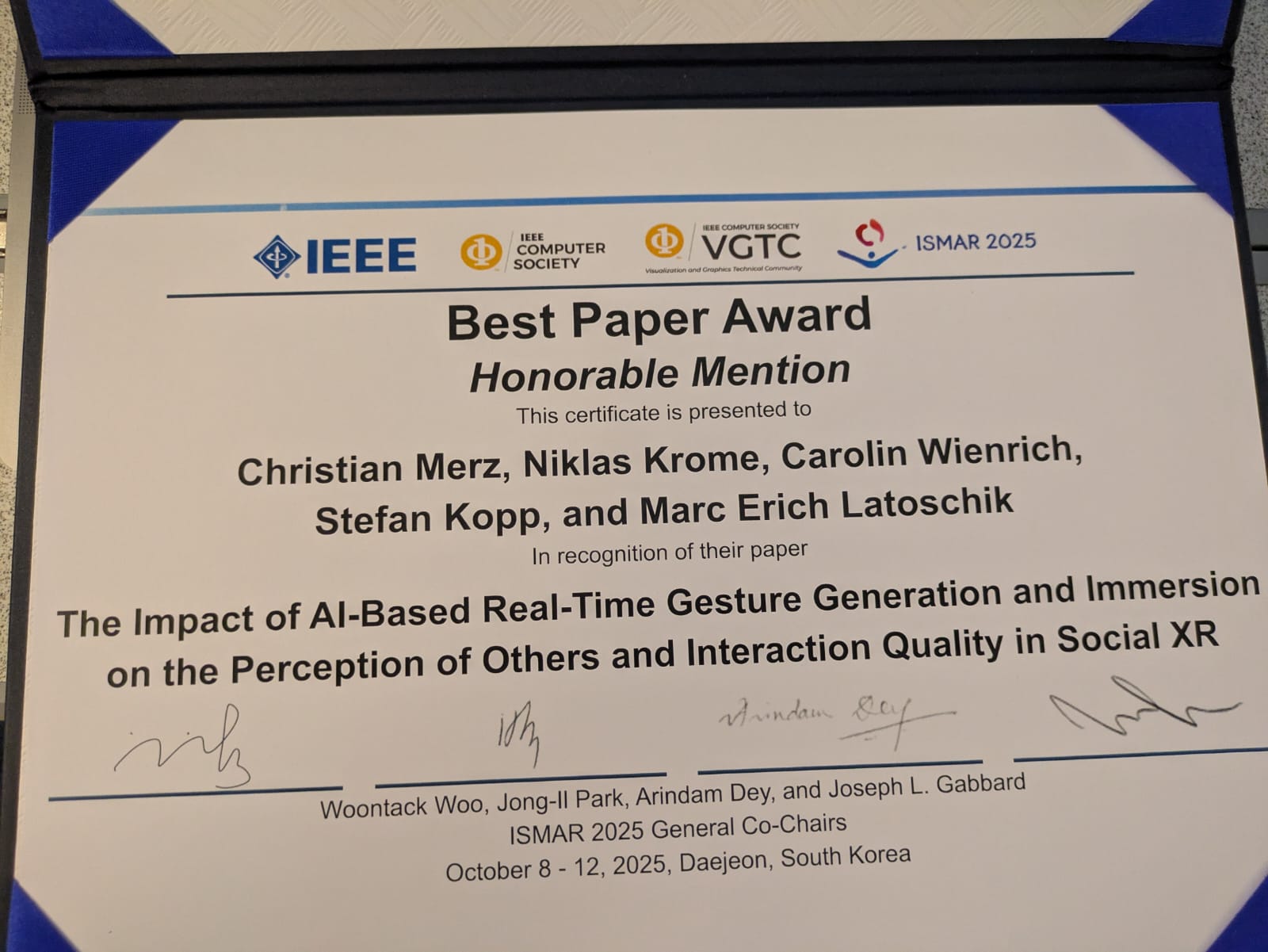
Best Paper Award Honorable Mention at IEEE ISMAR 2025
Our joint paper with colleagues from University of Würzburg on “The Impact of AI-Based Gesture Generation and Immersion on the Perception of Others and Interaction Quality in Social XR” received a Best Paper Award Honorable Mention at the 24th IEEE International Symposium on Mixed and Augmented Reality (ISMAR 2025) in Daejeon, South Korea.

Participating in Wallenberg Advanced Scientific Forum 2025
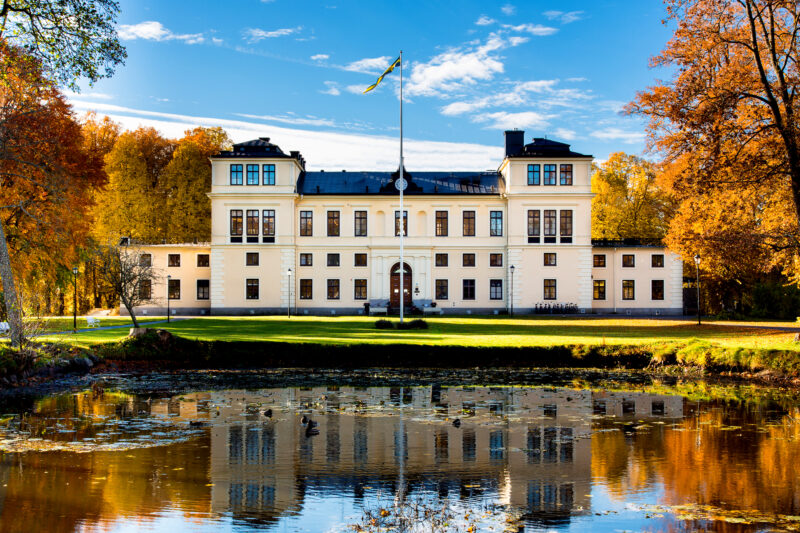
Excited to go to beautiful Rånäs Castle near Stockholm to participate in the Wallenberg Advanced Scientific Forum 2025 and to discuss with other experts how thorough and rigorous evaluation can be (and must) be a driver for generative AI.
Dialogue Researchers met at SemDial 2025 in Bielefeld
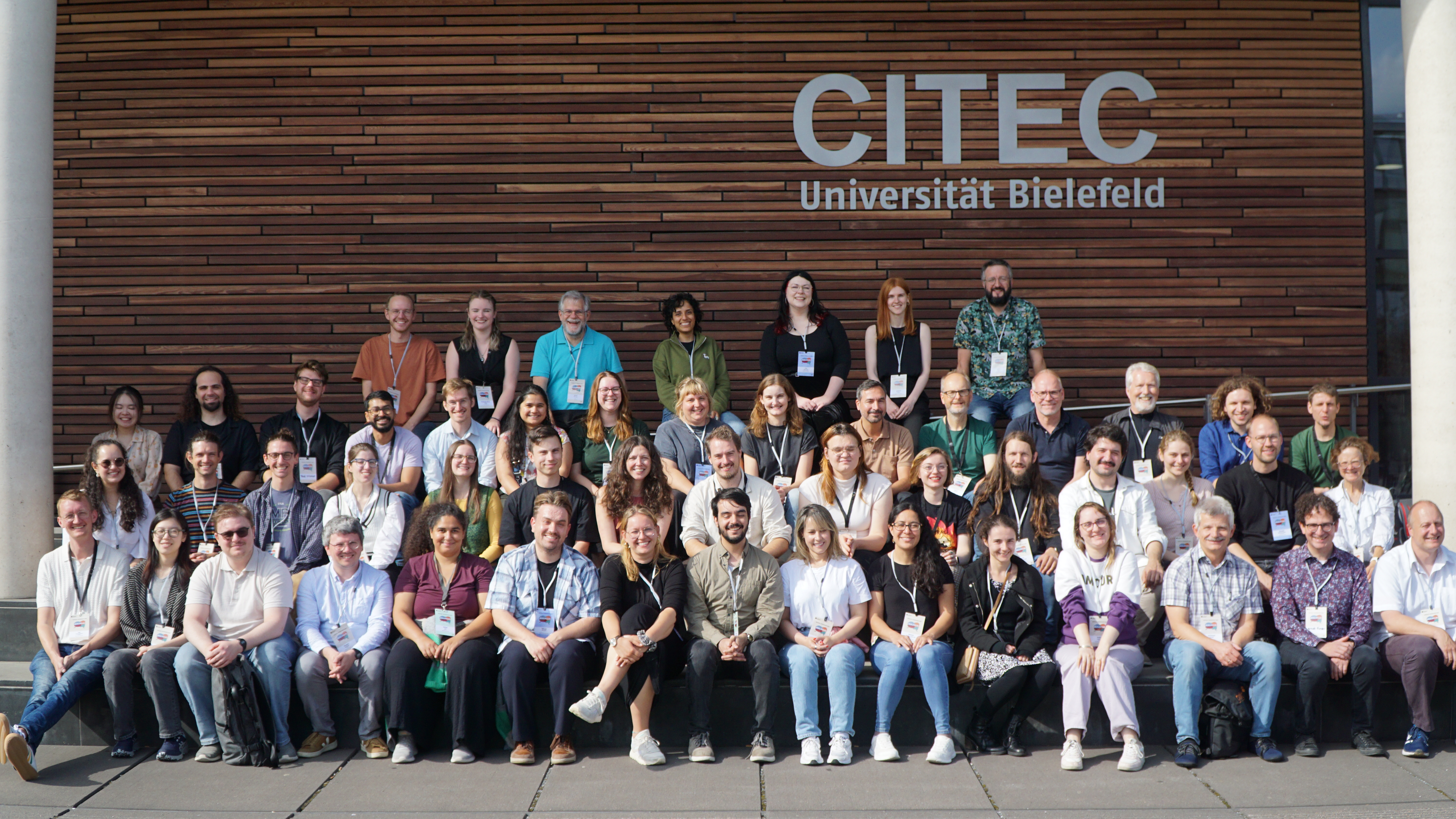
We organized, together with Hendrik Buschmeier and Sina Zarrieß, the 29th Workshop on the Semantics and Pragmatics of Dialogue (SemDial), this year called “Bialogue”. More than 50 researchers from Computer Science, Linguistics, Psychology and other disciplines met at CITEC to discuss latest findings and advancements in conversational interaction, dialogue and language technology.
Presentations at German Cognitive Science Conference (KogWis 2025)
Amelie and Dominik gave oral presentations at the German Cognitive Science Conference (KogWis 2025), held in Bochum. Presenting work carried out in TRR 318 (in subproject A01 and C05, respectively), Amelie talked about using cognitive partner models for adaptive explanation generation, while Dominik described how the, possibly biased, diagnostic reasoning of medical experts can be modeled computationally.
Speaking at RO-MAN 2025
Stefan gave a keynote at the Workshop on Interactive Task Learning in Human-Robot Co-Construction (ITL4HRI) at IEEE RO-MAN in Eindhoven (NL), speaking about the cognitive and communicative mechanisms of co-constructive task learning in human-robot interaction.